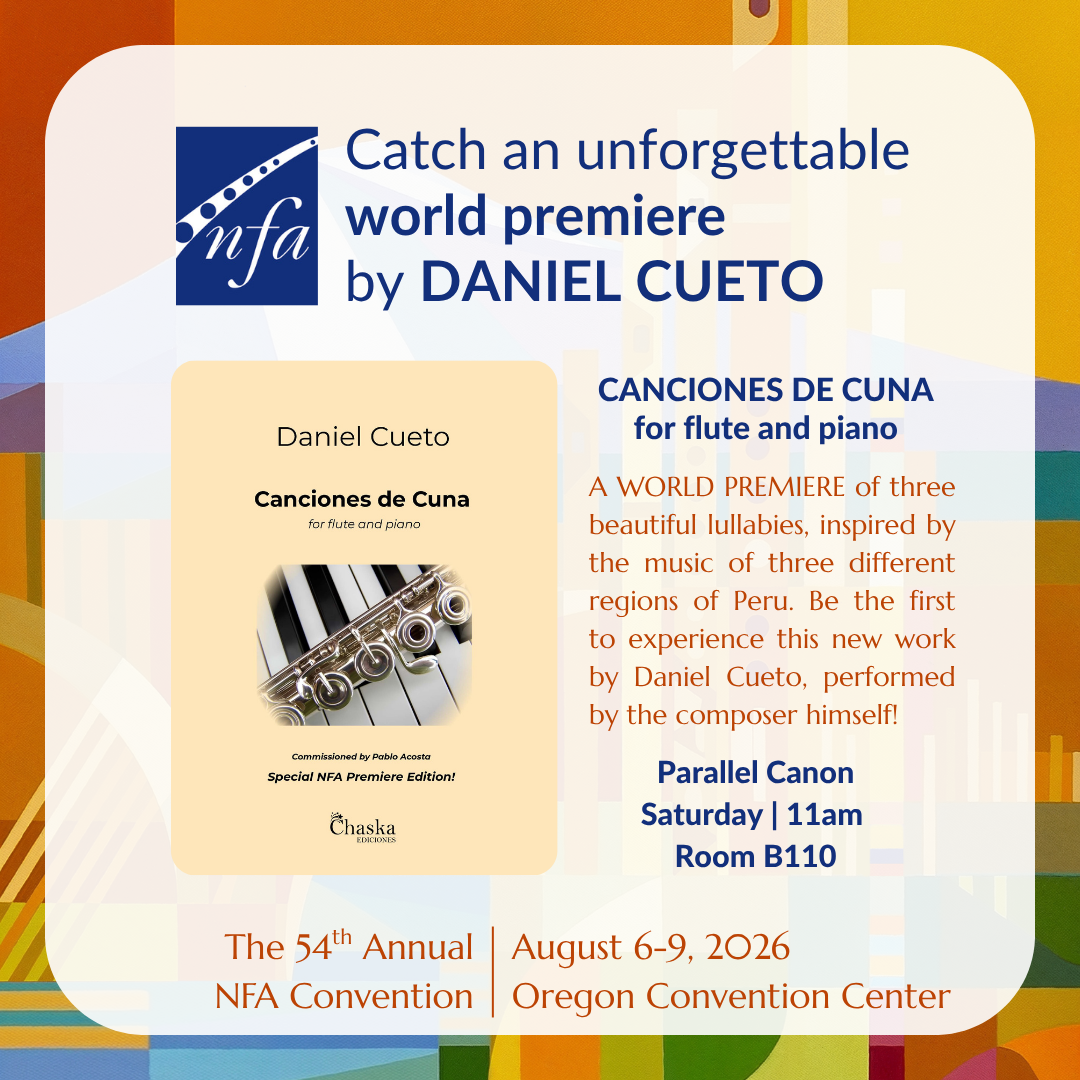
CANCIONES DE CUNA
for flute and piano (2026)


DETAILS
Commissioned by: Pablo Acosta
Duration: ca. 12 minutes
Instrumentation: Flute and piano
Movements:
“Canción Costeña” (Coastal Lullaby)
“Canción Andina” (Andean Lullaby)
“Canción Amazónica” (Amazonian Lullaby)
Premiere: August 9, 2026 at the National Flute Association Convention in Portland, Oregon (USA). Performed by the composer (flute), Xiao Wang (piano)
ABOUT
Short Description
Three beautiful lullabies inspired by different geographical and cultural regions of Peru.
Program Notes
"Canciones de Cuna" was commissioned by Pablo Acosta, a Peruvian flutist and entrepreneur based in Chicago and a friend of the composer. Both Pablo Acosta and Daniel Cueto were students of Lima-based flutist and composer Cesar Peredo, from whom they inherited a passion to create and promote a new flute repertoire that is distinctly Peruvian in its roots. For "Canciones de Cuna", Pablo requested from Daniel a set of new Peruvian lullabies that could authentically function as such in a real-world setting (beyond the concert stage), and that could be played with or without piano accompaniment.
Three beautiful pieces were born, each inspired by the musical traditions of a different geographical region. "Canción Costeña" (Coastal Lullaby) is based on the genre of the Afro-Peruvian panalivio, somewhat similar to a habanera. "Canción Andina" (Andean Lullaby) is influenced by the huayno genre, and "Canción Amazónica" (Amazonian Lullaby) is inspired by traditional shipibo songs known as ícaros, as well as newer pan-Amazonian commercial dance music.
The lullabies can be performed in many different contexts, whether as a set (in any order) or individually.
PERFORMANCE GUIDE
"Canción Costeña"
One of the main inspirations here is Susana Baca´s rendition of "Ven a mis brazos morena (Danza o habanera)". In this recording, notice the carefully crafted balance between the slow, flexible tempo and the crispness and precision of the syncopated rhythms. The mood is relaxed and soothing, yet the music is kept in motion through the constant thrust of the syncopations. There is a tension between these two elements that must be just right for this music to come to life. Achieving this balance is, in my experience, one of the key challenges for a successful performance of "Canción Costeña".
Another key challenge here is in the phrasing of the long-winded, "never-ending" melodic line. It is up to the performer to decide on points of departure and arrival, dynamic variation, breathing spots, and changes of sound color as the melody travels through many different harmonic places without ever losing its direction. This aspect of the piece is very much inspired by French music; useful listening includes Faure's "Morceau de Concours" (my favorite rendition is by Paul-Edmund Davies), and the slow movement of Ravel´s Piano Concerto in G Major (a wonderful example of a never-ending, heart-melting melody).
"Canción Andina"
The tendency here is to get excited with all the syncopation and play the piece too fast. The tempo (see metronome marking) should be very laid-back, not letting it be rushed by the bass part´s relentless offbeats. For an example of the general character of the tempo and syncopations in a slow huayno, listen to this example in the traditional guitar style of the Ayacucho province: “Huérfano Pajarillo”.
The melody is essentially pentatonic, but highly embellished; the harmony features many ninth chords and major-minor chords (such as C-Major on top of e-minor) that give the piece a dreamy, bittersweet aura. To me, Andean traditional music often lives in a bittersweet, major-minor place, as in these examples: “Tonada Triste” (Horacio Durán), “Coca Kintucha” (traditional), “Tomasa” (traditional).
"Canción Amazónica"
Compared to Coastal or Andean music, the traditions of the Peruvian Amazon have been far less often explored by Peruvian composers, and are generally lesser known in our capital city. For this piece, I drew inspiration from recordings of traditional ícaros of the shipibo nation, particularly “Ícaro for Protection During Sleep” (here sung by Herlinda Agustin Fernandez) and “Ícaro for a Lullaby” (here sung by Magdalena Flores Agustin). The vamps that are played using air sound are also inspired by the popular pan-Amazonian dance piece "Anaconda". Listen to the tracks to get a sense of their melodic and rhythmic qualities of the music from this part of Peru.